Laboratory for Testing in Aeronautical Engineering
The Laboratory for Testing in Aeronautical Engineering at the Department of Aeronautics was established to conduct research, improve teaching processes, and support the aviation community in building, testing, modifying,overhauling, and repairing the aircrafts to which national regulations apply.
The primary function of the laboratory is to enable students (and other interested groups) to acquire specific skills aimed at building, testing, modifying, overhauling, and repairing the following types of aircraft:
▪ amateur built aircraft
▪ former military aircraft
▪ research, experimental, or scientific aircraft
▪ specially regulated aircraft
▪ historic aircraft
▪ replicas of historic or former military aircraft
▪ microlight aircraft
▪ gyroplane.
The main activities of the Laboratory for Testing in Aeronautical Engineering
are:
Teaching activities
− conducting laboratory exercises for the Department of Aerotechnics courses of the undergraduate and graduate studies of Aeronautics and Air Traffic
− assigning bachelor’s and master’s theses that contain calculations for specific practical problems encountered during aircraft examination and testing.
− work shadowing for the students of the Faculty of Traffic and
Transport Sciences and other technical faculties.
Scientific activities
−application of scientific research work on specific industry problems − dissemination of research results through scientific papersmeeting − dissemination of research results through scientific papersmeeting the application requirements for scientific projects. Professional activities Professional activities
Professional activities
− professional support in constructing, testing, modifying, renovating, and repairing aircraft
− supervision of aircraft construction or renovation
− certification of aircraft construction or renovation.
Head of the laboratory, David Gerhardinger, mag. ing. aeroing., research assistant at the Department of Aeronautics, is the first person certified by the
Croatian Civil Aviation Agency as: an aeronautical expert approved to provide expert assistance in the construction, renovation, and testing of aircraft, supervise the construction or renovation of aircraft, and certify the construction or renovation of aircraft. Certificate reference: HR.ZS.001
▪ work supervisor approved for the supervision of construction or overhaul,
repair, and modification of aircraft, and their certification. Certificate
reference: HR.KR.001.
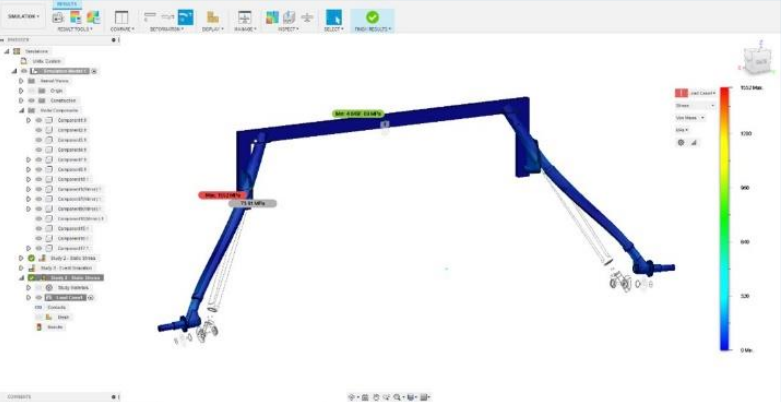
Autodesk Fusion 360 © 2020 (education license) simulation software
The program is used to create computer models of aircraft parts and components and simulation environments for: Analysis of deformations and stresses in the model due to imposed mechanical loads and boundary conditions. Defining deformations, stresses, and yielding criteria (numerical calculations are based on the assumption of the linear system response). Model vibration mode analysis considering the mechanical loads and boundary conditions acting on the model. The results include the main vibration modes and the corresponding frequencies. Analysis of the thermal conductivity of the electronic component model concerning the maximum allowable temperature and the influence of air convection. Analysis of the model’s response to thermal load under the conditions of constant thermal conductivity. The results include temperature distribution on the observed model. Analysis of temperature and stress distribution due to thermal and mechanical loads. Analysis of buckling shapes. Analysis of stresses and deformations of the model caused by mechanical loads and boundary conditions considering the nonlinear properties of the material. Model response analysis to time-varying loads and boundary conditions. Results include displacements, stresses, and deformations over a period of time. Model geometry optimization to reduce mass based on relevant loads and boundary conditions.
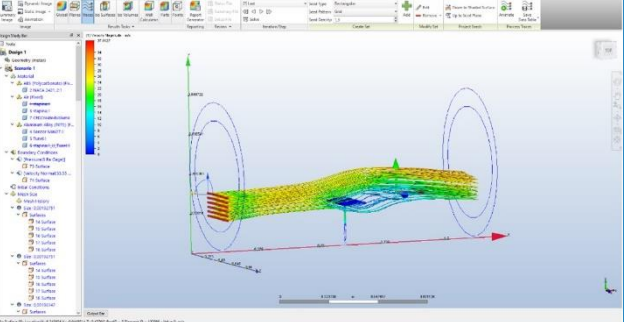
Autodesk CFD 2019 (education license) simulation so
The program is used to simulate fluid flow dynamics and its impact on a computer model to increase the accuracy of assessing aircraft performance and aerodynamic impacts during flight.
Application of the computer program in teaching: Conducting laboratory exercises at the undergraduate and graduate study of Aeronautics. Display of fluid dynamics on a computer model of an aircraft part, component, or the entire aircraft. The assignment of undergraduate and graduate theses, with or without a numerical problem, related to aircraft construction, testing, certification, overhaul, modification, and repair.
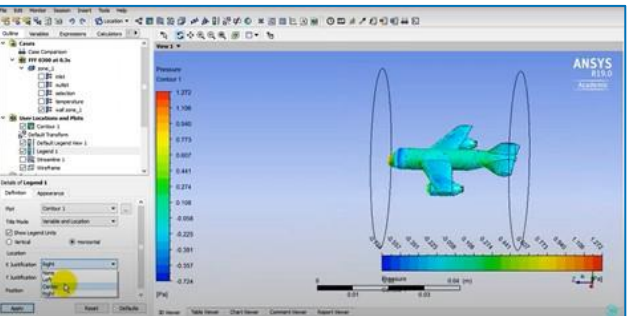
2020 R2 Ansys Workbench (academic-student license) simulation software
The program is used to analyse various problems related to aircraft construction, overhaul, testing, modification, and repair. The license allows access to the following modules: Ansys DesignSpace enables structural analysis based on numerical strength calculations. Ansys Mechanical is an FEA tool that enables the analysis of complex mechanical systems. Mechanical behaviour of components and sub-systems can be simulated and customized to test design variations. ANSYS Rigid Dynamics enables the analysis of rigid multi-body dynamics, such as landing gear systems in aircraft. Ansys Maxwell is an EM field solver for electric machines, transformers, wireless charging, permanent magnet latches, actuators, and other electric or mechanical devices. Ansys Multiphysics is used to analyse the effects of electromagnetic, structural, fluid, and thermal forces in combination. Ansys CFX is a pressure-based solver which needs no correction at low Mach numbers. Ansys Fluent is a fluid simulation software capable of advanced physics modelling and analysis of various fluid phenomena. ANSYS Fluent NOx enables the definition of multiple fuel streams. Ansys AUTODYN is an analysis tool for modelling the non-linear dynamics of solids, fluids, gas, and interaction. Ansys Forte is a computational fluid dynamics software for modelling internal combustion engines and positive displacement compressor
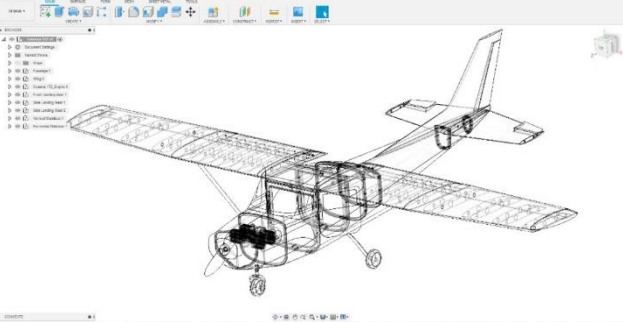
DefeAutodesk Inventor Professional 2020 CAD software
The program allows for 2D and 3D data integration in a single environment, creating a virtual representation of the aeronautical part or component to validate its form, fit, and function.
Application of the computer program in teaching: Conducting laboratory exercises at the undergraduate and graduate study of Aeronautics. Overview of aircraft construction and certification phases and aircraft certification specification compliance testing. Assigning bachelor’s and master’s theses, with or without a numerical problem, related to aircraft construction, testing, certification, overhaul, modification, and repair.